I watched Pale Flower 乾いた花 almost by accident. It had been sitting on a study list when I was watching Japanese films, and one day I noticed it was only about ninety minutes long. The title sounded nice.
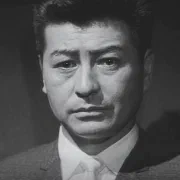
Two minutes into the film, the protagonist, Muraki, tells you immediately what kind of man he is. He just got out of prison and makes his way back to Tokyo. People are strange animals. Their faces look dead. They are desperately pretending to be alive. He killed one of them and spent three years in prison for it.
The translation read:
“Why make such a big deal about slaughtering one of these dumb beasts? I served three years for it. This is my turf. I didn’t hesitate to come right back. It’s a strange feeling. Somebody died. But nothing has changed.”
I raised my eyebrows. I was surprised, straightened my back and raised the volume. I had read anti-sentimental novels before. Bukowski, Carver, McCarthy, Didion. I like when people use words like that. However, I had not expected to find one of these films that speak through the same kind of literary bluntness—and to do so out of necessity for the story. The bluntness here doesn’t seem performed to please an audience.
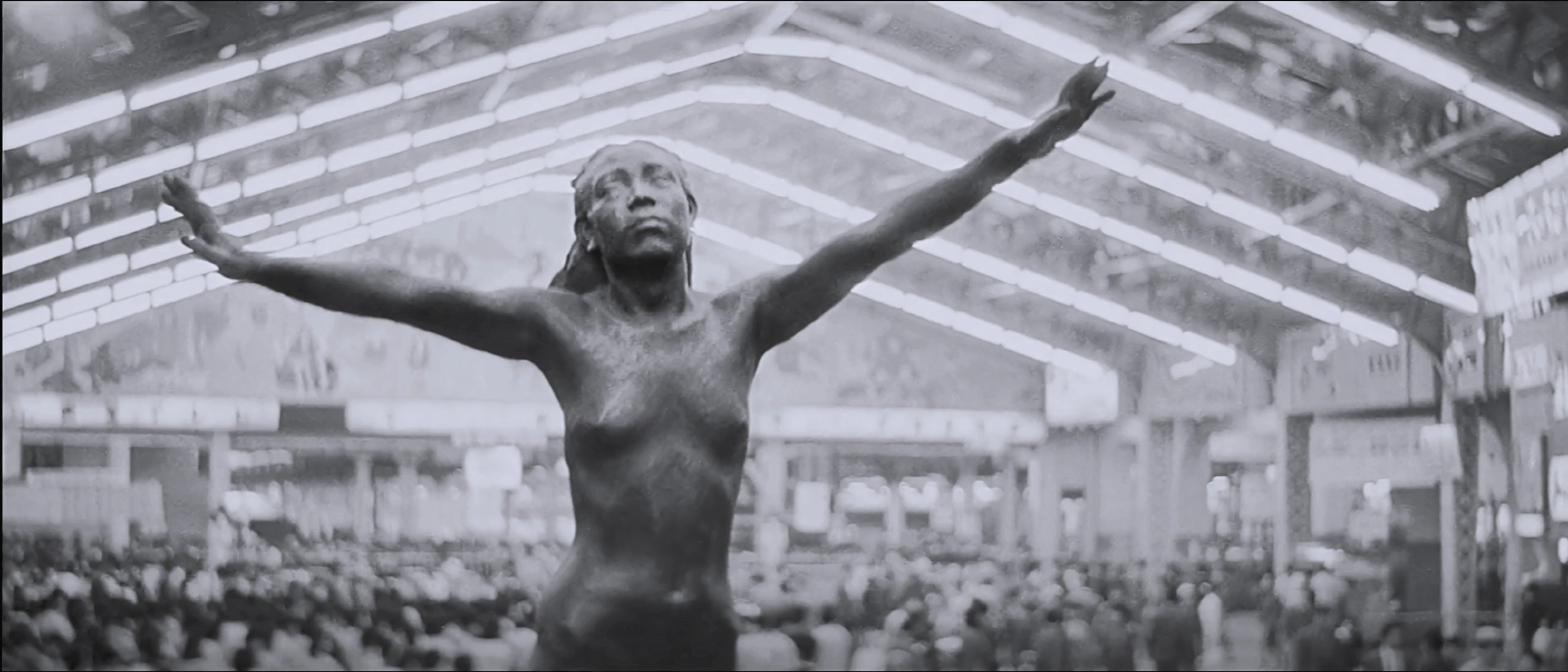
Muraki arrives in Tokyo and nothing has changed. To him, society is made of puppets. But there’s no puppeteer. Puppets, people, do their thing, because that’s what puppets do. It’s how he views himself too. And so Pale Flower is labeled a nihilistic and blunt film. That’s correct. Yet it stands out. Nihilistic crime dramas often portray futility through their protagonists’ increasingly desperate and reckless undertakings. Greed. Lust.
This one does it differently: Muraki expresses his rejection of humanity and meaning openly in the first frames. He sees the lack thereof clearly, yet doesn’t care to create his own meaning or worldview in place of the hollow void he perceives. He feels trapped within the dead system he so openly recognizes.
He says it all, and it does make sense, but there’s one move he’s short of. Society or life might’ve built his cage, yes, but the jailer is he. He could reach for the keys, unlock the cage, create meaning where he finds none. He doesn’t. He knowingly lets the system he agonizes over so much pull his strings. And he’s honest about it. Perhaps he even finds peace in playing along. And through all that, the audience is invited to kick back and watch along.
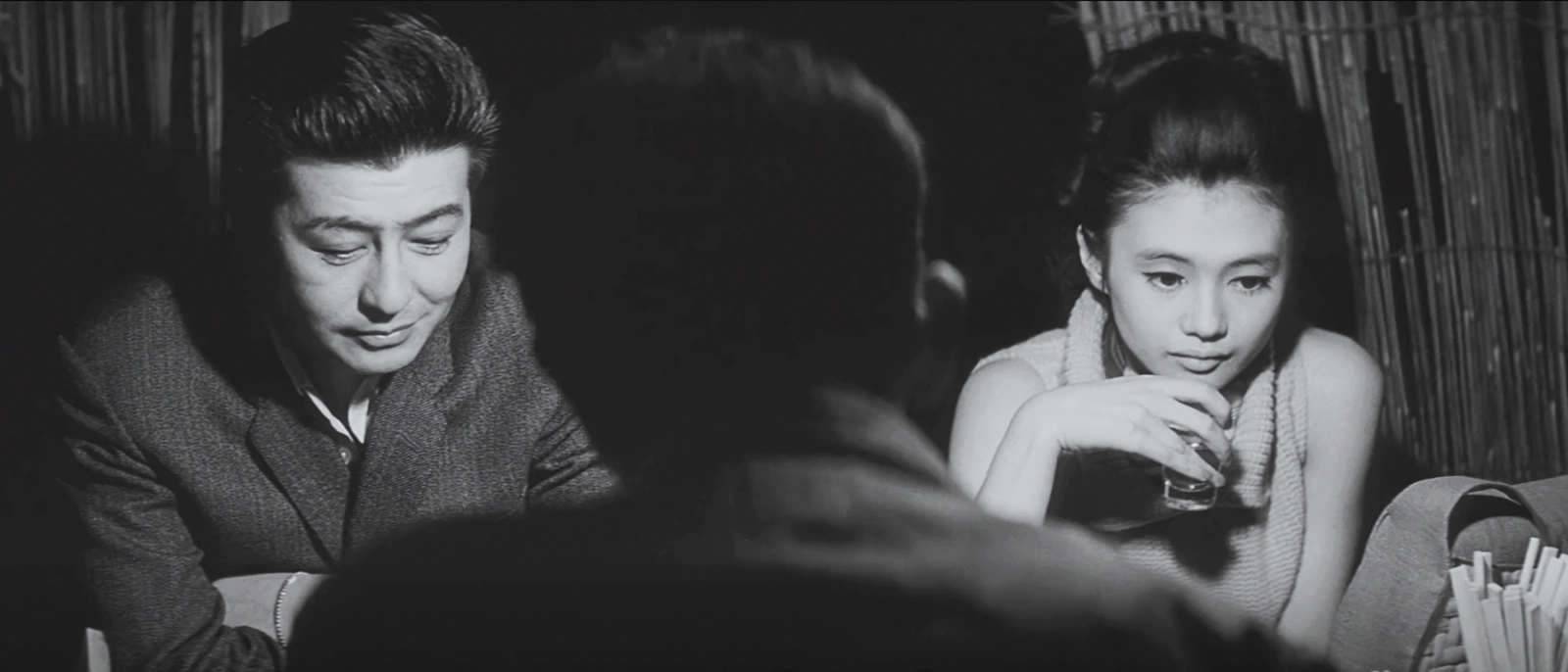
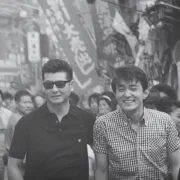
Muraki’s not dead inside; he isn’t even insensible. He meets two strangers: Saeko, the femme fatale of the film, and Jiro, a yakuza who tries to kill him with a knife and shortly after becomes his student of sorts. He handles them differently from the rest of his yakuza circle.
They’re both young, seek out thrills in the city’s black nights, and move through the same spaces he does. But they still carry innocence. What drives them seems to be the ever-hungry curiosity of young people, almost kids, who found themselves in an unforgiving world of great rewards and deadly lows too soon.
After his failed knife ambush, Jiro finds Muraki at a miserable dump with one foldable chair inside, his home, and throws him the finger he cut off. To make amends. It frustrates Muraki. He sees a young man who honors the gang traditions. Someone who lowered a knife onto his finger, cut through the skin, then got through the bone, and now feels proud of that. Muraki isn’t mad at the boy at all. He did try to kill him, because of course he did. He surrendered himself to the same machine Muraki exists in. It’s the game they play, after all. Why be mad at the kid?
Throughout the film, Muraki tries to look after Jiro. Still, he’s not trying to make Jiro leave that life behind. He probably knows by then that there’s no going back.
He’s not shocked by the ritual, not morally outraged that Jiro tried to murder him, and not especially interested in “saving” him.
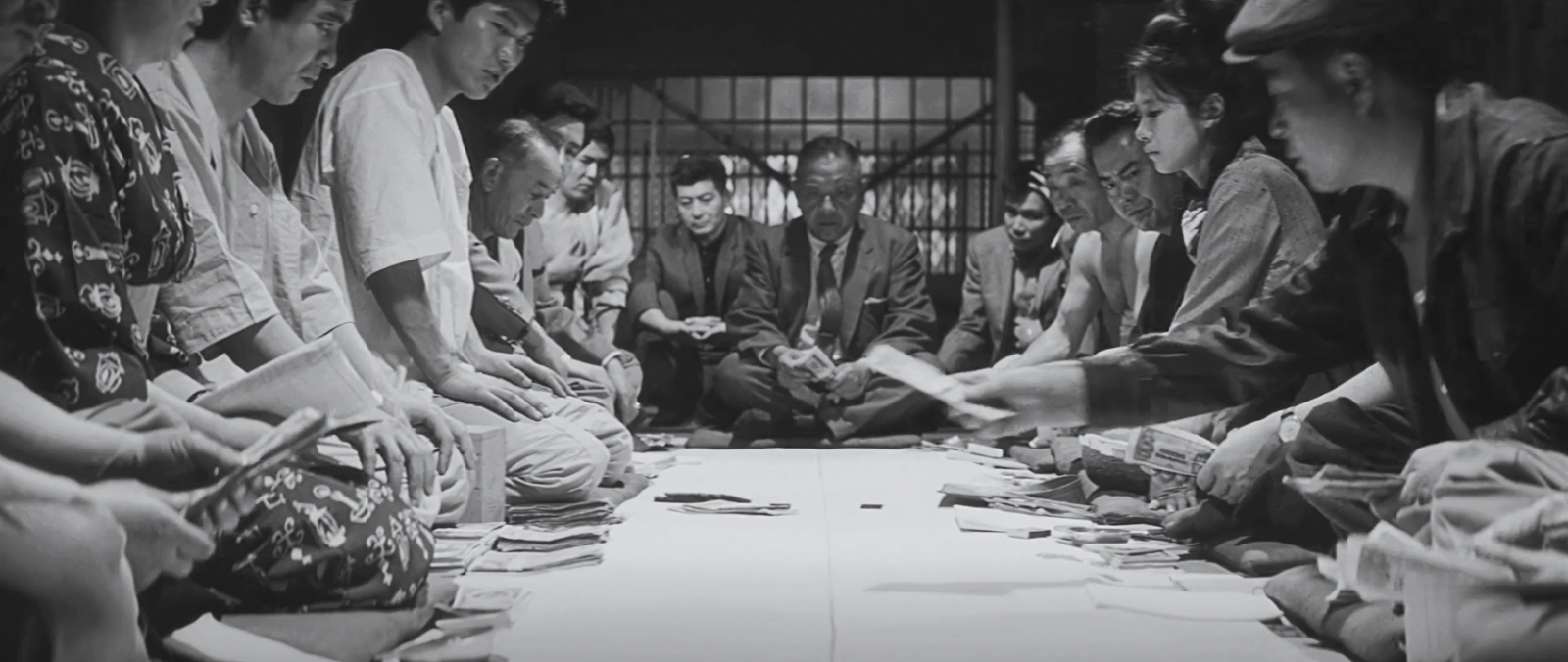
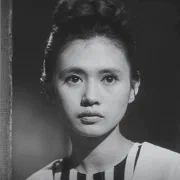
Saeko complicates things. She’s mysterious. She partakes in the yakuza’s illegal gambling events as if it was no big deal. Her identity remains unclear. She shows up in dodgy places, but only at night. She disappears before the sun rises over Tokyo. We have no idea who she really is. Although, perhaps we do know who she really is? Is her daylife just as hollow a shell as Muraki’s whole life? Or is daytime Saeko just nighttime Saeko in other dresses?
What we do know is that she’s at the other end of the same nihilistic condition Muraki lives in. They both perceive society and nightlife as one big stunt everybody performs. Him it numbs. He abandons all morals. For her it’s different. It electrifies her. It liberates her. She’s consumed by the possibilities that open up once one perceives danger, etiquette, and societal rules as suggestions rather than real constraints.
That’s probably why they recognize each other so quickly. They don’t merely share an appetite for gambling. They share a perception of unreality. The attraction comes from realizing that someone else has also noticed the stage machinery.
She moves something in Muraki that he had already declared dead. And, at times, he gives himself away. He’s concerned about Saeko’s reckless behavior. She talks of drugs and he does not like it. An old muscle within him moves, shows some last resistance. He doesn’t follow it, but that’s not exactly “nothing matters anyway”, is it, Muraki?
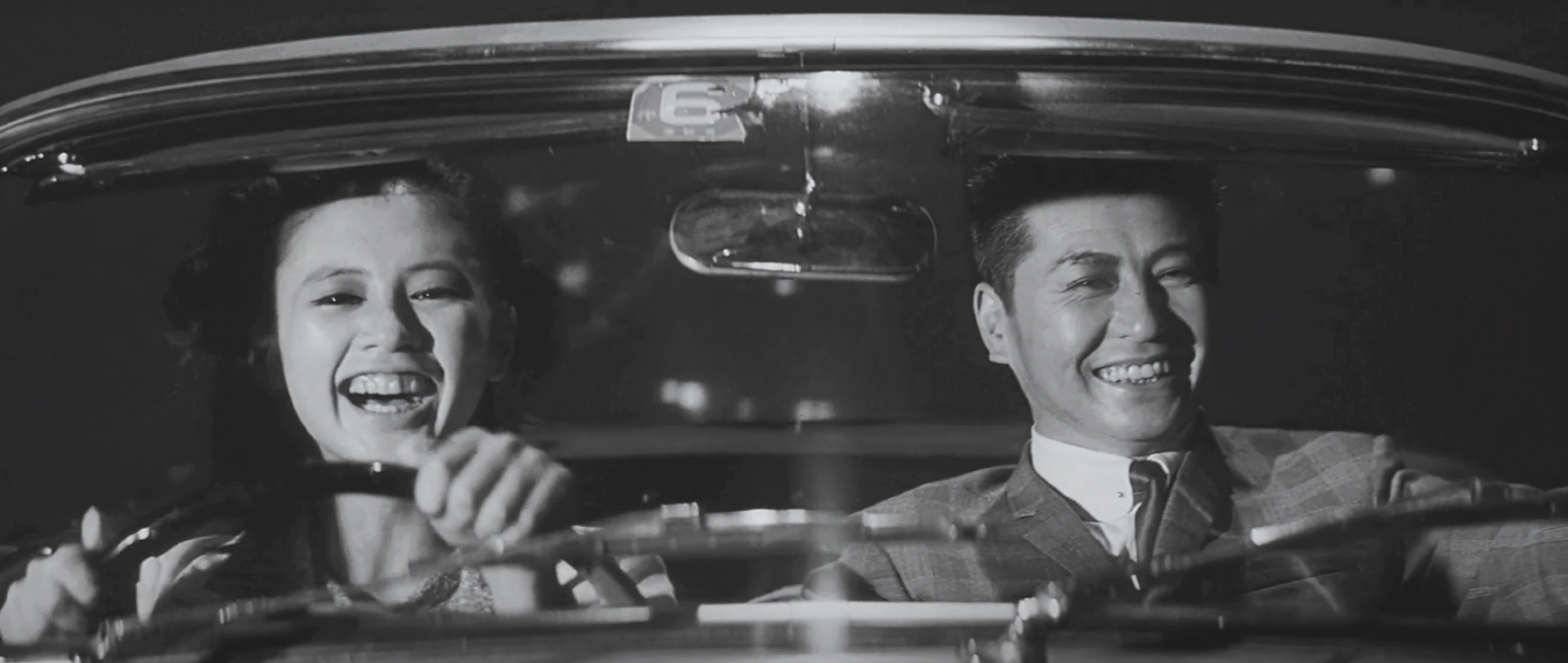
Muraki knows consequences are real. He went to prison. He murdered someone and claims he does not regret it, but he lives with it consciously. The gang at times dogs him and at times enshrines him. But because none of it produced meaning, he treats consequence as merely another mechanism.
Saeko seems almost to be testing whether consequences are real at all. She goes into increasingly dangerous places, gambles for high stakes, encounters drugs and violence, and repeatedly discovers that she can keep going. Her exhilaration might partly come from the world continually failing to stop her. Maybe she uses escalation as a way of asking reality to finally become serious. In which case, her wish will be fulfilled.
Pale Flower’s pace is never off. The film gives us its core struggle in the first frames, and everything it does afterward tests Muraki’s thesis against the film’s reality. People are constantly subjected to a harsh reality that doesn’t care, and are repeatedly challenged and exposed by the script. Shinoda sets a theme right away, and as the plot thickens, the whole film becomes increasingly dense. That is right up my alley.
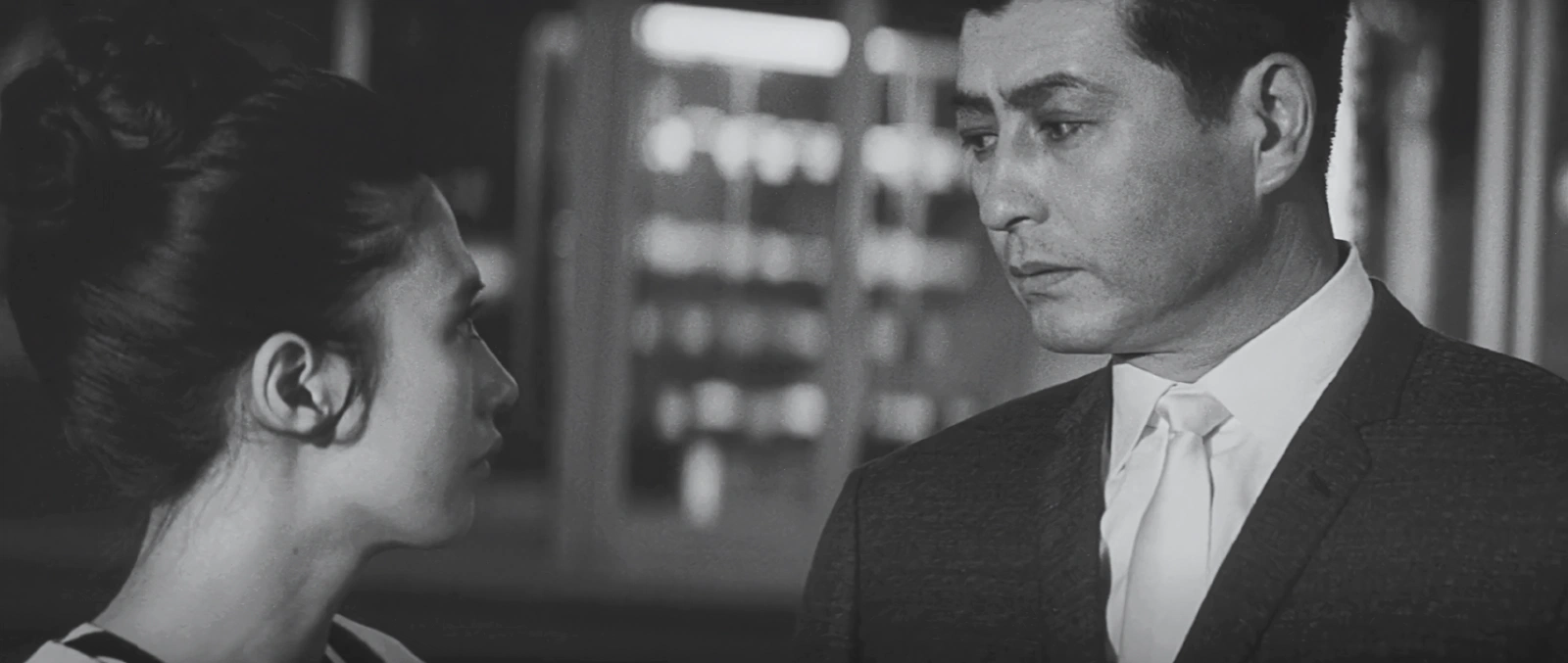
The film approaches its crescendo as they speak. In this moment Saeko’s false sense that reality is a game crumbles for the first time. Her face looks innocent, child-like, and we can see her expression collapse as she realizes mid-sentence that something serious is about to happen.
Both have been quietly circling one question all along: if everything is staged and consequences are irrelevant, what matters?
Muraki had already understood that Saeko seeks meaning in passion and danger. She’s either aware of the danger and doesn’t care, or almost entirely unaware of it.
He brings her along to a yakuza job. Only then, at the point of total escalation, can they finally, briefly, meet each other in felt reality. What he does is the one thing that makes him feel something—and seeing him do what he does is the most exciting thing Saeko has ever witnessed. She doesn’t blink as he kills a man. She returns his gaze. For a moment, he shows her that reality exists. That consequences are real. He surrenders himself to her. And then, witnessing Muraki overwhelmed, she makes him feel recognized. Muraki had devalued systems and humanity so much that only an immoral, overwhelming act of violence made him feel something strong enough that he’d consider it real.
He needed something so extreme that it would break through his abstraction; Saeko needed something so extreme that reality finally refused to remain a game. They arrived at the same event from opposite directions.
Films this bleak—
and unapologetic in their depiction of violence and subjectivity are somewhat of a rarity. Especially because Pale Flower, to me, does not merely use dark themes and make them look stylish. There’s much room for interpretation; that door is never shut. We have to come up with our own judgment of Muraki’s actions, or none at all, because the film doesn’t offer any. The movie we get is just as open to ambiguity and just as uninterested in moral judgment as its protagonist is. The form doesn’t stand above Muraki and correct him. It refuses to become the missing moral authority.
There’s also nothing to lean on: the protagonist is his own antagonist. Is he a bad guy? Is he a good guy gone bad? Or is he just “a guy”? Neither better nor worse than anyone else? There’s a part in that opening monologue I quoted earlier, where he calls himself “the scum of the earth”. Thinking about it, I’d probably call him a good guy gone bad. Or perhaps a guy gone bad. My best friend once said, “I think cynics must be some of the most sensible people. You have to be very sensible in the first place to end up a cynic”. I can see much of that in Muraki.
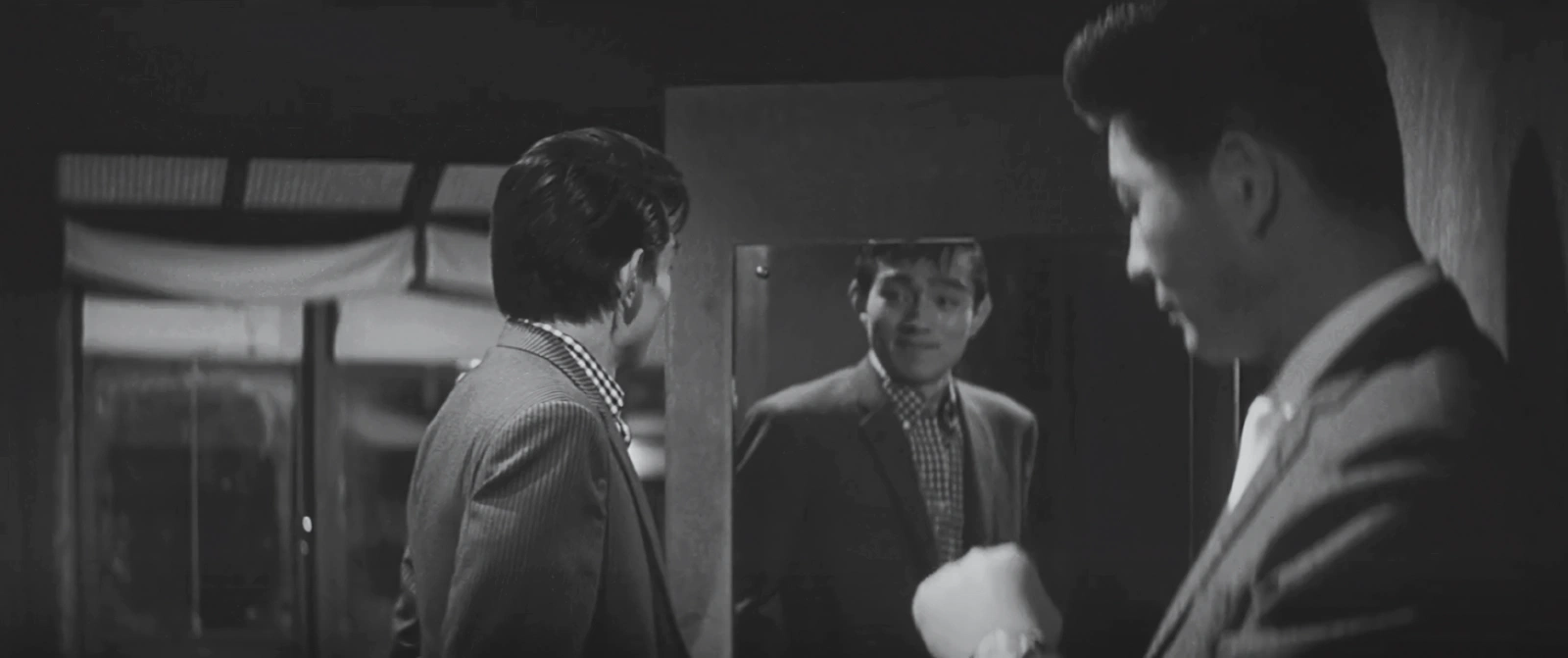
In the 2022 Sight and Sound Greatest Films of All Time poll, Michael Mann submitted ten films. One of them was Masahiro Shinoda’s Pale Flower. On the BFI page, the entry reads:
“For its incredible opening scenes alone.”
In his Essay, Roger Ebert wrote that Pale Flower is “one of the most haunting noirs” he’s seen. He goes on to say that Pale Flower is “an exercise in existential cool.” More interestingly, he wrote: “It involves a plot, but it is all about attitude.” He called the ending one of “bleak sadness and empty destiny”. He’s right.